02 11 2025 at 09:00
Project Managers as AI Ethics Leaders: From Hype to Honesty
Introduction
As AI reshapes how we work, questions of ethics and transparency are becoming central to project leadership. In this thought-provoking reflection, Paolo Alagna explores why authenticity and accountability must guide our use of AI and how project managers can lead by example in the age of intelligent machines.
AI in Projects: Beyond the Hype
Let me start with a promise: this is not another article about how to use AI in your projects. Honestly, I’m still waiting to see a real, embedded case study that goes beyond theory. There’s no shortage of conversations about what AI could do, but far fewer practical examples of what it actually does in daily project life. So no, this isn’t another “AI in Project Management” article.
And here’s my second confession: I have mixed feelings about calling it Artificial Intelligence. Not because I’m afraid of it, quite the opposite, I fully embrace this revolution. But calling it “intelligent” gives it a little too much credit, too early.
Yesterday, for example, I found myself arguing with Steevena, yes, that’s what I named my “Innovation Assistant,” because it didn’t know that Pope Francis had passed away or what happens at the Davos World Economic Forum.
Why Words Matter
Words matter. And for me, the word intelligence implies something human: the ability to manifest intentions and to distinguish right from wrong. When (and if) machines reach that point, it will not be a milestone for progress; it will mark the beginning of the end of humankind.
But that is another discussion, not the topic of this article.
From Hype to Honesty
AI, or more precisely, Generative AI, has become the unavoidable conversation of our time. Everywhere we look, on LinkedIn, in articles, in videos, we are surrounded by new tools, bold promises, and endless debates. Everyone talks about it, many claim to use it. Few can show real implementations in their daily work.
AI can make our jobs faster and, in some cases, even more efficient, but it also brings new challenges. We now live in a world where it is increasingly difficult to see where human effort ends and machine output begins.
And in that blur between man and machine, one truth stands out clearly: transparency is no longer optional; it is essential.
Transparency as a Professional Value
Being open about how we use AI is not a matter of compliance. It is a matter of professional respect, respect for our readers, our clients, our colleagues, and our profession.
I am a big admirer of Ricardo Vargas and Antonio Nieto-Rodriguez, two pioneers of modern project management. While listening to one of Ricardo’s five-minute podcasts about the World Economic Forum in Davos, something caught my attention. He mentioned that misinformation and disinformation, powered by AI, had been identified by world leaders as the top global risk. That made me curious, so I dug deeper.
The Global Risks Report 2025 confirmed it: AI-generated fake content has become the greatest short-term threat to social trust and stability.
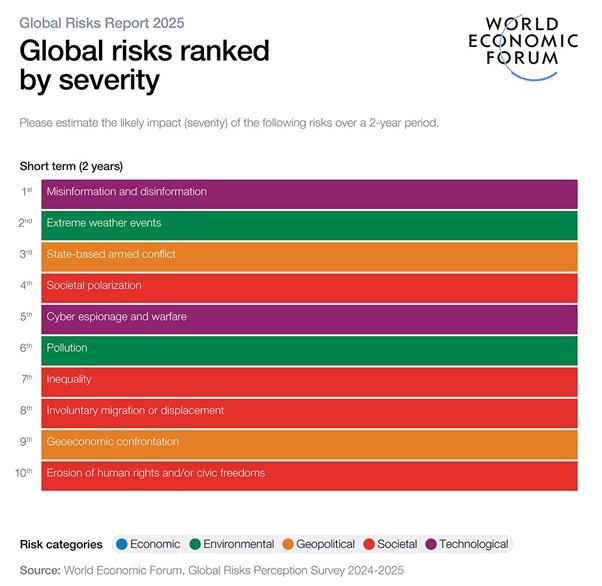
With deepfake videos, synthetic voices, and machine-written articles flooding our feeds, truth itself is becoming negotiable. And that is not only a media issue; it is a professional challenge.
As project managers, our success depends on our capacity to deliver value through our projects. But that value cannot exist without authenticity. Our ability to build genuine relationships remains at the core of our profession.
Yet many professionals risk creating a “doped” version of themselves online, one that looks impressive for a moment but quickly backfires, because credibility, once lost, is hard to regain.
At the end of the day, our influence does not come from how we appear, but from how we act with honesty and consistency.
Project Managers as Ethics Leaders
Project managers already operate at the crossroads of technology, people, and process. That unique position makes us the ideal professionals to lead by example in the age of AI.
Just as we manage scope, risk, and change, we must now learn to manage AI ethics and transparency, not because someone tells us to, but because our leadership credibility depends on it.
If we want to earn the trust of stakeholders, sponsors, and teams, we must show that technology does not replace judgment, it enhances responsibility. When we show integrity in how we use AI, we set a new standard for others to follow.
The AI Engagement Transparency Matrix
To make this principle practical, I propose the AI Engagement Transparency Matrix. It helps professionals clearly document which parts of their work are performed by humans and which are supported by AI.
Here is an example of an AI Engagement Transparency Matrix used during my latest keynote speech:
| Area of Application | Performed By |
|---|---|
| Literature Research | Author |
| Literature Processing | Author |
| Reference Formatting | ChatGPT |
| Concept Clarification | Author |
| Text Editing | Author |
| Text Refinement | ChatGPT |
| Visual Aids (via SORA) | ChatGPT |
| Fact and Citation Verification | Author |
This table is not about compliance or self-defense; it is about trust. It is a transparent statement that says: “I use AI, but I remain fully accountable for my work.”
Including this matrix at the end of an article, a report, or a presentation builds credibility. It invites others to do the same and raises the overall ethical standard of our profession.
Five Ways to Lead with Transparency
As project managers, we can integrate this mindset into everyday work, in ways that are practical, measurable, and visible.
- Include AI transparency in project governance.
When defining processes or templates, add a simple question: “Was AI used in this step? If so, how?” - Apply the matrix in project documentation.
Use it in reports, lessons learned, or communications to show where automation supports the team. - Coach your team on ethical AI use.
Encourage others to disclose AI contributions, not to control them, but to normalize honesty. - Model the behavior.
When you use AI yourself, share openly what it did and what you validated manually. Transparency spreads by example. - Celebrate human-AI collaboration.
Emphasize that AI is a tool, not a threat. True professionalism lies in using it responsibly.
A Culture of Trust
Through these small actions, we turn transparency from a personal choice into an organizational habit.
If you are a project manager, you already have what it takes to lead this transformation. You understand systems, you manage change, and you value integrity.
By doing this, you are not just being transparent. You are building a culture of trust, one that will define the future of the project management profession.
The next generation of leaders will not be judged by how perfectly they hide AI, but by how openly and ethically they use it. AI will not replace project managers, because in the end, technology can automate tasks, but only humans can build trust.
Let us make that our differentiator. Let us ensure that in a world filled with artificial voices, ours remains authentic, credible, and human.
Paolo Alagna
Director of Professional Development, PMI Belgium Chapter
professional.development@pmi-belgium.be
This article was originally published on ProjectAbility and is republished here with permission from the author.