09 02 2020 at 11:54
PMBOK® Guide 7: An Interview with the Co-Author
Interview: Nader K Rad
Interview by: Frank Turley
Month: January 2020
Introduction
As you may be aware, the exposure draft of the 7th edition of the PMBOK Guide is available now, and will be open until February 14th for comments. It’s a new version that’s been built from scratch, with a completely new approach.
Another interesting fact about this new version is that one of the 12 co-authors is a Belgian chapter member, Nader K. Rad ( https://www.linkedin.com/in/naderkrad/). I’ve used this opportunity to interview him and ask him some of the commonest questions about this version.
Frank: So, Nader, we’re used to seeing about 700 pages of content in the PMBOK Guide, b
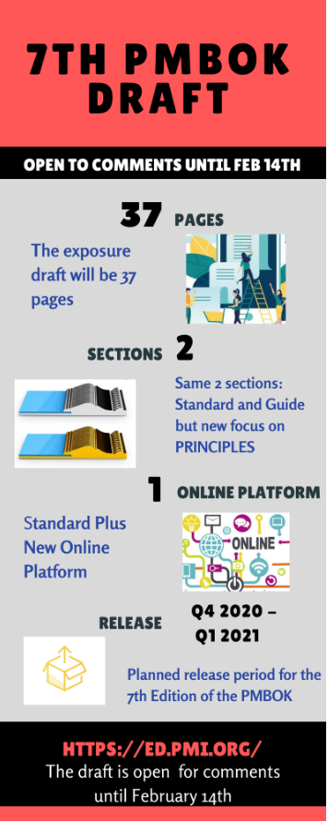 ut when we open the exposure draft, there’s only 37 pages! Can you tell us what’s happening?
Nader: Well, the PMBOK Guide has the goal of supporting every type of project, and to satisfy this goal, more and more content has been added in each update, leading to about 700 pages in the current edition. However, there were two problems with it: one was that being this large makes it hard for the audience to understand and use it, and the second problem was that the existing structure and approach was not suitable to cover every type of project.
To solve the problems, the new version uses a new approach that really makes it possible to cover every type of project. Because of the flexibility of the new approach, we didn’t have to add a lot of content for every type of project, and we aimed for 200 to 250 pages for the final product.
The PMBOK Guide has, and had, two main sections: the standard, and the guide. In the current and previous editions, the standard is where the processes are explained from the process groups point of view, and the guide is where they are discussed, in more detail, from the knowledge areas point of view. The new version also has those two sections, but only the standard is made available in the public exposure, and that’s why it’s only 37 pages.
Frank: OK, that explains the size. What’s the new approach that you mentioned?
Nader: All previous versions of the PMBOK Guide were based on processes, meaning that processes were the main element around which all concepts were explained. The primary element in the new version is principles rather than processes.
Frank: Like PRINCE2?
Nader: Yes and no. The principles in PRINCE2 support the scope of PRINCE2, which is the project management methodology. The principles of the PMBOK Guide are designed to support the scope of the PMBOK Guide, which is both broader and at a higher level. In other words, there are some aspects, such as the relationship between project managers and the rest of the teams, or professional conduct, which are the subject of the principles in the PMBOK Guide, but outside the scope of PRINCE2.
Frank: Does this mean that the PMBOK Guide won’t have processes any more?
Nader: Another change is that besides the two main sections of the book, the standard and the guide, there’s also an online platform called Standards Plus. The book will be updated every four years or so, and will contain the most fundamental aspects, while the online platform will be fully dynamic and updated continuously with new content that is aligned with the book and will support it in different ways. The book may describe an abstract approach that can be helpful to every project, whereas the online platform will expand it, with multiple entries, each explaining how that aspect can be materialized in different types of project.
Because processes are most useful when they are concrete, they will be best suited to the online platform instead of the book. So, to summarize, the book doesn’t have the processes anymore, but the processes are not dead, and will be expanded and elaborated on the online platform.
Frank: So, how does it apply to the PMP exam? Is it going to be only about the book, or the online platform as well?
Nader: The PMBOK Guide is only one of the resources for the PMP exam. It’s up to the team responsible for the new version of the exam to decide whether the online platform can also be one of the resources, and I’m not involved in that.
Frank: OK. Let’s go back to the principles. Can you explain why being principle-based can be more flexible and helpful?
Nader: A common problem in projects is that people do certain things and create certain artifacts that match what the methodologies and frameworks are asking them to, and yet they don’t get the expected results. This is so because many of them don’t understand the purpose of what they’re doing, and when you don’t understand the purpose, what you create can’t serve the purpose and won’t generate value. That’s why it’s a good idea to start with the purposes, or ultimate expectations, or whatever you’d like to call them, create the necessary understanding, and then proceed to the concrete ways of realizing them, which would be processes, artifacts, and so on.
On the other hand, there used to be the idea that the processes needed for managing different types of project are similar, and that all that is needed is to tailor them; but nowadays, it seems that processes can be very different depending on the project environment and the product that is being built. As a result, processes can’t be the primary element in a general guide to project management.
Frank: But would it be practical, or too theoretical?
Nader: It won’t be practical in the sense that principles alone are not enough for making things happen, and people still need to have a way to realize them. On the other hand, they are practical in the sense that they give meaning to what people would do.
Let us see it from a different perspective. If we take an imaginary scenario where someone can be provided with only principles or only with processes/artifacts/tools/etc., I believe that principles would be more helpful to them. When they understand the principles, they can still discover or invent ways of work that would satisfy those principles whereas if all they have are processes and the like, they rarely pause and try to discover the reasons behind those elements.
Frank: When you mention covering every type of project, is it about Agile projects?
Nader: That’s one important concern: to create something that can be helpful both for predictive projects and for adaptive or Agile projects. However, it is not limited to that, as supporting both small and large projects is also important. Supporting hobby projects, normal projects, and critical projects is also important. There are many differentiating factors about projects.
Frank: All right – so, when will we have the final version, including the guide?
Nader: I think it will be released in the fourth quarter of 2020 or the first quarter of 2021.
Frank: What about the online platform?
Nader: A different team works on the online platform, and I don’t know all the details about it, but I’ve seen a beta version of it, and I think it’s open to a limited number of members for review. I suppose the final version will be launched by the time the book is released, but it may happen sooner.
Frank: The last question I have is about comments: Who is expected to give comments? What types of comments are expected? And what happens to the comments you receive?
Nader: Anyone can comment on the draft, even people who are not members of PMI.
Any type of comment is welcome; however, comments about typos and grammar won’t be useful because the text will change a lot before the final version, and it will be copy-edited anyway.
More than one team member will review each comment we receive. If any of the team members find a comment special or critical, they will mark it to be discussed in the group. Otherwise, they will submit their opinion about the comment. If all opinions are the same about a comment, that joint opinion will be applied, otherwise the comment will be reviewed again.
Frank: That sounds like a lot of work!
Nader: Yes! It is going to be a lot of work!
Frank: OK, thanks Nader. Do you have any final words?
Nader: Thank you too! I hope the new version will be useful to the community. We’re looking forward to receiving comments, and I hope the members of the Belgian Chapter will provide us with many comments.
---
If you’re interested in reading the exposure draft and providing feedback, you can find it here: http://ed.pmi.org/
Remember that the exposure draft is only available until 14th of February.