14 11 2025 at 09:00
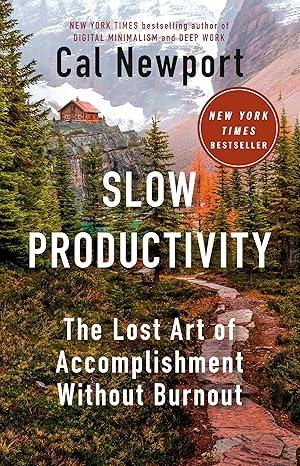
Book Review: "Slow Productivity: The Lost Art of Accomplishment Without Burnout" by Cal Newport
Who is Cal Newport?
Cal Newport is a computer science professor at Georgetown University, renowned author, and productivity philosopher. Known for challenging conventional wisdom about work, focus, and digital culture, he has carved a niche as one of today’s most original thinkers on the future of knowledge work.
His previous books Deep Work, So Good They Can’t Ignore You, and Digital Minimalism have influenced executives, creatives, and students alike to rethink how they use their attention and time.
In Slow Productivity, Newport takes his trademark contrarian stance a step further, calling for a rebellion against the culture of overload. Instead of measuring productivity by hours worked or emails answered, he argues for quality over quantity and meaningful accomplishment over constant busyness.
Key Ideas Behind Slow Productivity
Slow Productivity: The Lost Art of Accomplishment Without Burnout is Cal Newport’s latest and most mature call for reform in the way we work. It is not a book about getting more done. It is about getting the right things done, sustainably.
Newport dissects the modern obsession with visible activity such as endless emails, check-ins, dashboards, and digital “presence” that masquerade as productivity, and exposes it for what it is: performance, not progress. In his view, we have optimized the modern workplace for motion, not meaning.
Question for you: How much of your workday is "performance" (looking busy) versus "progress" (doing meaningful work)?
Newport's latest book is not about doing less to be lazy. It is about doing fewer, better things to achieve great, lasting results. It is about building a legacy instead of just getting burned out.
The Three Principles of Slow Productivity
To rebuild a healthier model of professional achievement, Newport proposes three guiding principles of slow productivity:
- Do fewer things: Instead of scattering our attention across dozens of low-impact initiatives, Newport urges us to protect focus for the few essential efforts that truly create value. By pruning the unnecessary, professionals can channel depth and mastery into what remains.
- Work at a natural pace: Humans are not algorithms, and meaningful progress follows a rhythm, not constancy. Newport draws on examples from nature, art, and science to show that great work often emerges through cycles or periods of intensity followed by rest, incubation, and reflection.
- Obsess over quality: Rather than chasing metrics or arbitrary deadlines, Newport advocates a craftsman’s mindset, where excellence and longevity replace speed and quantity as the ultimate measures of success.
Throughout the book, Newport intertwines insights from history, philosophy, and modern work science. From Jane Austen’s disciplined writing routine to Newton’s reflective isolation during the plague years, he illustrates how some of humanity’s greatest accomplishments arose from slow, deliberate effort rather than frantic multitasking. These examples are not nostalgia; they are evidence that enduring achievement requires time, solitude, and focus, qualities the modern workplace has systematically eroded.
Beyond the theory, Newport turns his attention to application. He explores how individuals and organizations alike can translate slow productivity into practice. He suggests rethinking how workloads are designed, especially for knowledge workers, to allow deep and uninterrupted work. He introduces “focus rituals” as a counterweight to distraction and proposes embracing seasonal productivity, where intense creative bursts are naturally followed by slower periods of rest, planning, or maintenance. This cyclical model challenges the “always-on” mindset that dominates today’s professional culture.
At its core, Slow Productivity redefines what it means to be productive in the 21st century. Newport does not argue for doing less as an excuse for laziness; he frames it as an act of strategic wisdom. Doing fewer things, more slowly, and with greater care is not a retreat from ambition; it is a return to the kind of ambition that builds legacies rather than burnout.
Practical Lessons for Project Managers
While Slow Productivity is written for a global audience, its message lands particularly well in the European context where project managers often face hybrid teams, cross-border compliance, and the constant pressure to “do more with less.” Newport’s framework provides a mental reset that helps PMs manage both the pace and purpose of work.
Here are several practical applications:
- Reclaiming Focus in Multi-Country Projects (e.g., EU-funded programs)
- Problem: EU projects often juggle complex reporting, multiple stakeholders, and bureaucratic overhead.
- Application: By applying Newport’s “Do fewer things” principle, a PM could streamline reporting templates, centralize communication tools, and eliminate redundant update meetings.
- Example: In a Horizon Europe research project with seven partner institutions, the PM introduced a two-tier communication rhythm with one monthly strategic sync and one asynchronous status log. The team reduced meeting hours by 40% and delivered output faster with better documentation.
Two-Tier Communication: Stop having constant status-update meetings. Use one tool for asynchronous (non-urgent) updates, such as a shared log, and reserve meetings only for strategic decisions.
- Balancing Workload in Matrix Organizations (e.g., Automotive or Pharma)
- Problem: PMs in Europe’s manufacturing or pharma sectors often handle multiple concurrent projects with tight regulatory deadlines.
- Application: Using Newport’s concept of working at a natural pace, PMs can implement rolling capacity reviews every sprint, adjusting scope instead of squeezing time.
- Example: A project office in Stuttgart adopted “focus weeks,” periods free of internal presentations, allowing engineers to dive deep into design validation. The result: improved quality and fewer post-launch defects.
The "Slow Sprint": If you use a project method like Scrum, dedicate every fourth or fifth iteration purely to polishing, refining, and reflection. This is where quality gets baked in, reducing costly rework later.
- Reducing Burnout in Distributed Teams (e.g., Belgium–Poland–Netherlands setups)
- Problem: Culturally diverse teams often fall into the trap of over-communication and misaligned expectations.
- Application: The PM applies slow productivity by setting clear “deep work windows” where messages and meetings are minimized.
- Example: In an ERP rollout spanning Antwerp, Kraków, and Amsterdam, the PM implemented “Quiet Tuesdays,” where there are no Teams calls before 14:00. Productivity metrics improved and reported stress levels dropped significantly.
The "Quiet Tuesday": Implement a deep work window for you and your team, for example, no meetings or internal messaging before 2 PM on Tuesdays. This forces focus and gives everyone time for real work.
- Improving Stakeholder Management in Public Projects
- Problem: Municipal or EU-funded initiatives often equate progress with visible activity through constant updates, press releases, or dashboards.
- Application: By shifting focus to quality over visibility, PMs can present fewer, more meaningful milestones instead of endless progress noise.
- Example: A city infrastructure PM in Copenhagen reduced progress meetings with the contractor from weekly to bi-monthly but required richer deliverables and post-review reflections. Both trust and output quality increased.
- Embedding Craftsmanship into Deliverables (e.g., Digital Transformation Projects)
- Problem: Many digital projects fall into “release fatigue” because of constant small launches with no time for refinement or deep understanding of the work.
- Application: Newport’s “obsess over quality” approach translates into deliberate craftsmanship by using quality gates and reflective reviews to refine deliverables.
- Example: A fintech PM in Paris introduced a “slow sprint” every fifth iteration, dedicated purely to design and UX polishing. Customer satisfaction jumped, and rework costs fell by 25%.
Final Thoughts
For project managers operating in multicultural, highly regulated, and complex environments, Slow Productivity, as mentioned before, is not just philosophical; it is strategic.
It legitimizes a leadership style that values focus over frenzy, impact over visibility, and long-term resilience over short-term performance theater. These are lessons we also heard during the COVID-19 crisis.
Grégor Nicolas
PMI Belgium Chapter member